
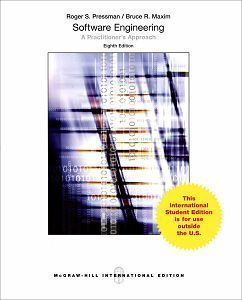
Software Engineering: A Practitioner's Approach 8/e
售價
$
1,200
- 一般書籍
- ISBN:9781259253157
- 作者:Roger Pressman, Bruce Maxim
- 版次:8
- 年份:2015
- 出版商:McGraw-Hill
- 頁數/規格:941頁/平裝雙色
書籍介紹
本書特色
目錄
作者介紹
Description
For almost three decades, Roger Pressman's Software Engineering: A Practitioner's Approach has been the world's leading textbook in software engineering. The new eighth edition represents a major restructuring and update of previous editions, solidifying the book's position as the most comprehensive guide to this important subject.
The eighth edition of Software Engineering: A Practitioner's Approach has been designed to consolidate and restructure the content introduced over the past two editions of the book. The chapter structure will return to a more linear presentation of software engineering topics with a direct emphasis on the major activities that are part of a generic software process. Content will focus on widely used software engineering methods and will de-emphasize or completely eliminate discussion of secondary methods, tools and techniques. The intent is to provide a more targeted, prescriptive, and focused approach, while attempting to maintain SEPA's reputation as a comprehensive guide to software engineering.
The 39 chapters of the eighth edition are organized into five parts - Process, Modeling, Quality Management, Managing Software Projects, and Advanced Topics. The book has been revised and restructured to improve pedagogical flow and emphasize new and important software engineering processes and practices.
For almost three decades, Roger Pressman's Software Engineering: A Practitioner's Approach has been the world's leading textbook in software engineering. The new eighth edition represents a major restructuring and update of previous editions, solidifying the book's position as the most comprehensive guide to this important subject.
The eighth edition of Software Engineering: A Practitioner's Approach has been designed to consolidate and restructure the content introduced over the past two editions of the book. The chapter structure will return to a more linear presentation of software engineering topics with a direct emphasis on the major activities that are part of a generic software process. Content will focus on widely used software engineering methods and will de-emphasize or completely eliminate discussion of secondary methods, tools and techniques. The intent is to provide a more targeted, prescriptive, and focused approach, while attempting to maintain SEPA's reputation as a comprehensive guide to software engineering.
The 39 chapters of the eighth edition are organized into five parts - Process, Modeling, Quality Management, Managing Software Projects, and Advanced Topics. The book has been revised and restructured to improve pedagogical flow and emphasize new and important software engineering processes and practices.
Features
- McGraw-Hill is pround to offer Connect with Pressman's Software Engineering: A Practitioner's Approach, 8e. This innovative and powerful system helps your students learn more efficiently and gives the ability to assign homework problems simply and easily. Problem are graded automatically, and the results are recorded immediately. Track individual student performance - by question, assignment, or in relation to the class overall with detailed grade reports. ConnectPlus provides students with all the advantages ofConnect, plus 24/7 access to an eBook.
- Pressman's Software Engineering: A Practitioner's Approach, eighth edition, includes the power of McGraw-Hill’s LearnSmart--a proven adaptive learning program that helps students learn faster, study more efficiently, and retain more knowledge through a series of adaptive questions. This innovative study tool pinpoints concepts the student does not understand and maps out a personalized plan for success.
- Four new chapters, emphasizing software security and the unique challenges of developing software for mobile applications, have been added to this edition.
- Many new Problems and Points to Ponder have been added. The Further Readings and Information Sources sections have been revised extensively and many new figures and examples are used.
- Each of the book's 39 chapters again begins with a popular "Quick Look" that provides immediate short answers to six questions about chapter content.
- Use of the marginal icons and important complimentary text information is found throughout the book.
- A collection of sidebars continues to be used to enhance the reading experience by providing supplementary information that will be of use to the reader.
Table of Contents
1 The Nature of Software
2 Software Engineering
Part One The Software Process
3 Software Process Structure
4 Process Models
5 Agile Development
6 Human Aspects of Software Engineering
Part Two Modeling
7 Principles That Guide Practice
8 Understanding Requirements
9 Requirements Modeling: Scenario-Based Methods
10 Requirements Modeling: Class-Based Methods
11 Requirements Modeling: Behavior, Patterns, and Web/Mobile Apps
12 Design Concepts
13 Architectural Design
14 Component-Level Design
15 User Interface Design
16 Pattern-Based Design
17 WebApp Design
18 MobileApp Design
Part Three Quality Management
19 Quality Concepts
20 Review Techniques
21 Software Quality Assurance
22 Software Testing Strategies
23 Testing Conventional Applications
24 Testing Object-Oriented Applications
25 Testing Web Applications
26 Testing MobileApps
27 Security Engineering
28 Formal Modeling and Verification
29 Software Configuration Management
30 Product Metrics
Part Four Managing Software Projects
31 Project Management Concepts
32 Process and Project Metrics
33 Estimation for Software Projects
34 Project Scheduling
35 Risk Management
36 Maintenance and Reengineering
Part Five Advanced Topics
37 Software Process Improvement
38 Emerging Trends in Software Engineering
39 Concluding Comments
Appendix I-An Introduction to UML
Appendix II-Object-Oriented Concepts
Appendix III-Formal Methods
1 The Nature of Software
2 Software Engineering
Part One The Software Process
3 Software Process Structure
4 Process Models
5 Agile Development
6 Human Aspects of Software Engineering
Part Two Modeling
7 Principles That Guide Practice
8 Understanding Requirements
9 Requirements Modeling: Scenario-Based Methods
10 Requirements Modeling: Class-Based Methods
11 Requirements Modeling: Behavior, Patterns, and Web/Mobile Apps
12 Design Concepts
13 Architectural Design
14 Component-Level Design
15 User Interface Design
16 Pattern-Based Design
17 WebApp Design
18 MobileApp Design
Part Three Quality Management
19 Quality Concepts
20 Review Techniques
21 Software Quality Assurance
22 Software Testing Strategies
23 Testing Conventional Applications
24 Testing Object-Oriented Applications
25 Testing Web Applications
26 Testing MobileApps
27 Security Engineering
28 Formal Modeling and Verification
29 Software Configuration Management
30 Product Metrics
Part Four Managing Software Projects
31 Project Management Concepts
32 Process and Project Metrics
33 Estimation for Software Projects
34 Project Scheduling
35 Risk Management
36 Maintenance and Reengineering
Part Five Advanced Topics
37 Software Process Improvement
38 Emerging Trends in Software Engineering
39 Concluding Comments
Appendix I-An Introduction to UML
Appendix II-Object-Oriented Concepts
Appendix III-Formal Methods
Roger S Pressman, R.S. Pressman & Associates, Inc
Bruce R. Maxim, University of Michigan
Bruce R. Maxim, University of Michigan
