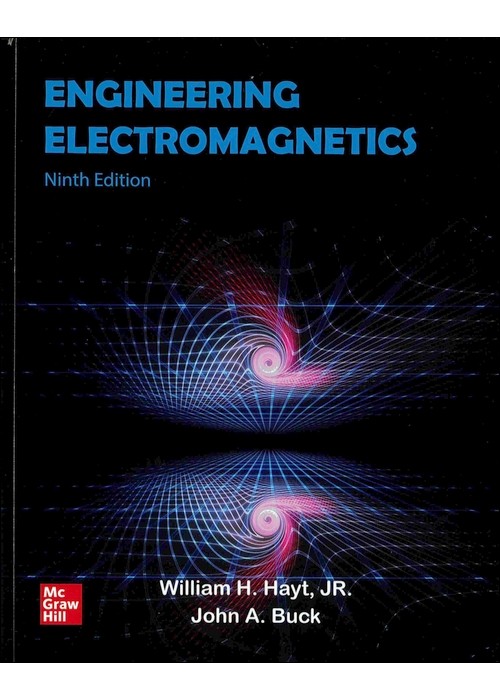
(VitalSource eBook) Engineering Electromagnetics 9/e
- ◉ VitalSource◉ 閱讀期限:Lifetime
售價
$
1,000
- 電子書
- ISBN:9781260288858
- 作者:William H. Hayt, John A. Buck
- 版次:9
- 年份:2019
- 出版商:McGraw-Hill
- 頁數/規格:電子書
- 參考網頁:Engineering Electromagnetics 9/e
書籍介紹
本書特色
目錄
►VitalSource 電子書購買須知:
First published almost 60 years ago, and now in its Ninth Edition, Engineering Electromagnetics by Hayt/Buck is a classic text that has been updated for electromagnetics today. This widely respected book stresses fundamental concepts and problem solving, and discusses the material in an understandable and readable way. Numerous illustrations and analogies are provided to aid the reader in grasping the difficult concepts. In addition, independent learning is facilitated by the presence of many examples and problems.
Knowledge of electromagnetic field theory is more important than ever for the electrical engineer. Examples that demonstrate this include the continuing expansion of high- speed wireless and optical fiber communication. Additionally, the need continues for ever-smaller and denser microcircuitry, in which a command of field theory is essential for successful designs. The more traditional applications of electrical power generation 9 and distribution remain a focus.
- 閱讀期限:Lifetime
- 電子書兌換碼將於 3-5 個工作天,寄送至「序號寄送 E-mail」所填寫的信箱。
- 根據消費者保護法第 19 條第 1 項規定,本產品為數位內容,售出後恕不接受退貨或退款。
- 本產品僅限台灣境內使用,海外 IP 無法註冊或啟用。
- 電子書平台登錄與註冊說明 (eText-Register.pdf)。
- 電子書平台操作手冊 (eText-Manual.pdf)。
- 如有任何問題,請 Email 至 ebook@tunghua.com.tw。
First published almost 60 years ago, and now in its Ninth Edition, Engineering Electromagnetics by Hayt/Buck is a classic text that has been updated for electromagnetics today. This widely respected book stresses fundamental concepts and problem solving, and discusses the material in an understandable and readable way. Numerous illustrations and analogies are provided to aid the reader in grasping the difficult concepts. In addition, independent learning is facilitated by the presence of many examples and problems.
Knowledge of electromagnetic field theory is more important than ever for the electrical engineer. Examples that demonstrate this include the continuing expansion of high- speed wireless and optical fiber communication. Additionally, the need continues for ever-smaller and denser microcircuitry, in which a command of field theory is essential for successful designs. The more traditional applications of electrical power generation 9 and distribution remain a focus.
Key Features of the Ninth Edition
- Updated Content: Throughout the text, the presentation of topics was made more concise and explanations were edited to support students? comprehension. Early in the book, new introductory material has been added to many sections to give perspective and to facilitate understanding.
- Accessible Organization: The book was written to make It as easy as possible for the reader to learn independently. This has been done by applying a carefully graduated scale of difficult within each chapter and among the chapters themselves. In addition, all of the chapters are now sub-sectioned to improve organization and to make topics easier to locate.
- Pedagogical Tools: Numerous examples and drill problems are integrated throughout each chapter to help reinforce the concepts presented and to give reader a chance to check their understanding. One hundred new problems have been added, mostly replacing older problems that could be considered well worn. Every problem has a three-point difficulty scale next to it.
- Website: The website for the book, www.mhhe.com/hayt/buck9e, contains many additional resources. These resources include advanced topic modules, as well as a set of illustrations, animations, interactives, and quizzes to enhance the reader's understanding. Icons appear in the text margins to indicate topics that have additional material on the website.
Table of Contents
Chapter 1: Vector Analysis
Chapter 2: Coulomb's Law and Electric Field Intensity
Chapter 3: Electric Flux Density, Gauss' Law, and Divergence
Chapter 4: Energy and Potential
Chapter 5: Conductors and Dielectrics
Chapter 6: Capacitance
Chapter 7: The Steady Magnetic Field
Chapter 8: Magnetic Forces, Materials and Inductance
Chapter 9: Time-Varying Fields and Maxwell's Equations
Chapter 10: Transmission Lines
Chapter 11: The Uniform Plane Wave
Chapter 12: Plane Wave Reflection and Dispersion
Chapter 13: Guided Waves
Chapter 14: Electromagnetic Radiation and Antennas
Appendix A Vector Analysis
Appendix B Units
Appendix C Material Constants
Appendix D The Uniqueness Theorem
Appendix E Origins of the Complex Primitivity
Appendix F Answers to Odd-Numbered Problems
Chapter 1: Vector Analysis
Chapter 2: Coulomb's Law and Electric Field Intensity
Chapter 3: Electric Flux Density, Gauss' Law, and Divergence
Chapter 4: Energy and Potential
Chapter 5: Conductors and Dielectrics
Chapter 6: Capacitance
Chapter 7: The Steady Magnetic Field
Chapter 8: Magnetic Forces, Materials and Inductance
Chapter 9: Time-Varying Fields and Maxwell's Equations
Chapter 10: Transmission Lines
Chapter 11: The Uniform Plane Wave
Chapter 12: Plane Wave Reflection and Dispersion
Chapter 13: Guided Waves
Chapter 14: Electromagnetic Radiation and Antennas
Appendix A Vector Analysis
Appendix B Units
Appendix C Material Constants
Appendix D The Uniqueness Theorem
Appendix E Origins of the Complex Primitivity
Appendix F Answers to Odd-Numbered Problems
同系列書籍
電磁學,9789863415237,9781260084566
電磁學,9781260084566
Electromagnetics