
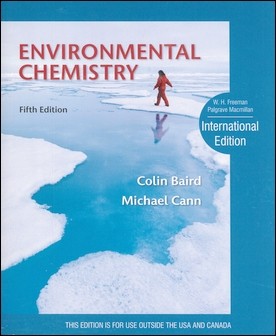
Environmental Chemistry 5/e
售價
$
1,950
- 一般書籍
- ISBN:9781464113499
- 作者:Colin Baird, Michael Cann
- 版次:5
- 年份:2012
- 出版商:W. H. Freeman and Company
- 頁數/規格:848頁/平裝雙色
書籍介紹
目錄
Description
Colin Baird and Michael Cann's acclaimed Environmental Chemistry helps students explore the chemical processes and properties underlying environmental issues they hear about every day - climate change, pollution, biofuels, sustainability and more. Like no other textbook of its kind, it makes accessible the many ways chemists are tackling fundamental environmental problems – including those for which the chemical industry itself is a source.
With up-to-date, balanced, and authoritative coverage of soil, water, and air chemistry, the Fifth Edition offers:
Colin Baird and Michael Cann's acclaimed Environmental Chemistry helps students explore the chemical processes and properties underlying environmental issues they hear about every day - climate change, pollution, biofuels, sustainability and more. Like no other textbook of its kind, it makes accessible the many ways chemists are tackling fundamental environmental problems – including those for which the chemical industry itself is a source.
With up-to-date, balanced, and authoritative coverage of soil, water, and air chemistry, the Fifth Edition offers:
- Expanded coverage of energy production (especially biofuels), the generation and disposal of CO2, and innovative ways to combat climate change.
- Increased international coverage to give all students a better perspective on environmental problems and solutions around the world – for example, increased coverage of gaseous and particulate air pollution and CO2 emissions and air quality standards in both developed and developing countries.
- Updated Green Chemistry cases, including new cases on bio-based toners, recycling carbon dioxide, VOCs in latex paints, bio-based liquid fuels and chemicals, and spinetoram-an improved green pesticide.
- An Activity in most chapters - Web- or library-based mini-projects to be completed either by an individual student or as a group project.
- More schematic diagrams have been added to promote student comprehension of the more complicated chemistry and appeal to a variety of learning styles.
- Marginal notes – to supplement the main text with additional interesting material, and to indicate which Review Questions are relevant to the material at hand.
Table of Contents
PART I: ATMOSPHERIC CHEMISTRY AND AIR POLLUTION
1. Stratospheric Chemistry: the Ozone Layer
2. The Ozone Holes
3. The Chemistry of Ground-Level Air Pollution
4. The Environmental and Health Consequences of Polluted Air - Outdoors and Indoors
PART II: ENERGY AND CLIMATE CHANGE
5. The Greenhouse Effect
6. Energy Use, Fossil Fuels, CO2 Emissions, and Global Climate Change
7. Biofuels and Other Alternative Fuels
8. Renewable Energy Technologies: Hydroelectric, Wind, Solar, Geothermal, and Marine Energy and Their Storage
9. Radioactivity, Radon, and Nuclear Energy
PART III: WATER CHEMISTRY AND WATER POLLUTION
10. The Chemistry of Natural Waters
11. The Pollution and Purification of Water
12. Toxic Heavy Metals
PART IV: TOXIC ORGANIC COMPOUNDS
13. Pesticides
14. Dioxins, Furans and PCBs
15. Other toxic Organic Compounds of Environmental Concern
PART V: ENVIRONMENT AND THE SOLID STATE
16. Wastes, Soils, and Sediments
PART VI: ADVANCED ATMOSPHERIC CHEMISTRY
17. The Detailed Free-Radical Chemistry of the Atmosphere
Appendix A: Oxidation Numbers and Redox Equation Balancing Reviewed
Answers to Selected Odd-Numbered Problems
Index.
PART I: ATMOSPHERIC CHEMISTRY AND AIR POLLUTION
1. Stratospheric Chemistry: the Ozone Layer
2. The Ozone Holes
3. The Chemistry of Ground-Level Air Pollution
4. The Environmental and Health Consequences of Polluted Air - Outdoors and Indoors
PART II: ENERGY AND CLIMATE CHANGE
5. The Greenhouse Effect
6. Energy Use, Fossil Fuels, CO2 Emissions, and Global Climate Change
7. Biofuels and Other Alternative Fuels
8. Renewable Energy Technologies: Hydroelectric, Wind, Solar, Geothermal, and Marine Energy and Their Storage
9. Radioactivity, Radon, and Nuclear Energy
PART III: WATER CHEMISTRY AND WATER POLLUTION
10. The Chemistry of Natural Waters
11. The Pollution and Purification of Water
12. Toxic Heavy Metals
PART IV: TOXIC ORGANIC COMPOUNDS
13. Pesticides
14. Dioxins, Furans and PCBs
15. Other toxic Organic Compounds of Environmental Concern
PART V: ENVIRONMENT AND THE SOLID STATE
16. Wastes, Soils, and Sediments
PART VI: ADVANCED ATMOSPHERIC CHEMISTRY
17. The Detailed Free-Radical Chemistry of the Atmosphere
Appendix A: Oxidation Numbers and Redox Equation Balancing Reviewed
Answers to Selected Odd-Numbered Problems
Index.
