
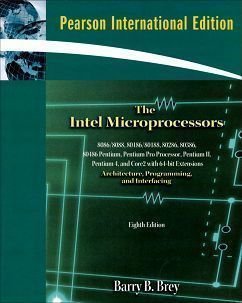
The Intel Microprocessors: 8086/8088, 80186/80188, 80286, 80386, 80486, Pentium, Pentium Pro Processor, Pentium II, Pentium III, Pentium 4, and Core2 with 64-bit Extensions Architecture, Programming, and Interfacing 8/e
售價
$
1,300
- 一般書籍
- ISBN:9780137140947
- 作者:Barry B. Brey
- 版次:8
- 年份:2008
- 出版商:Pearson Education
- 頁數/規格:925頁/平裝單色
書籍介紹
目錄
Features
New to This Edition
- Illustrated concepts for students with 200 relevant programming examples, many written in Visual C++ with embedded assembly language code.
- Coverage of how to develop software to control application interfaces to the microprocessor.
- Coverage of how to program the microprocessor using the popular Microsoft Visual C programming environment with embedded assembly language to control personal computers.
- Coverage of how to develop software to control the keyboard, video display, and various other components in the computer system.
- Coverage of how to program the numeric coprocessor, the MMX, and SSE units to solve complex equations.
- Explanation of the differences between family members and highlight the features of each member.
- Descriptions of how to use real mode (DOS) and protected mode (Windows) of the microprocessor.
- Explanation of how to use the operation of the memory manager to control the protected mode and paging unit to allocate memory.
- Coverage of how to interface memory and I/O systems to the microprocessor.
- Coverage of how to develop software to drive hardware interfaces and applications.
- Explanation of the operation of a real-time operating system (RTOS) in an embedded environment.
- Explanation of the operation of the disk and video systems.
- Coverage of how to interface small systems to the ISA, PCI, parallel and serial ports, and USB of a personal computer system.
- Coverage of the 64-bit extension (EMT-64) of the Pentium 4 microprocessor
New to This Edition
- Coverage of the latest Pentium 4 and Core2 processors, including how to program the Pentium Core 2 and its new 64-bit architecture.
- An explanation of how to interface C/C++ using Visual C++ Express (a free download from Microsoft) with assembly language for both the older DOS and the Windows environments.
- Updated sections that detail new events in the fields of microprocessors and microprocessor interfacing.
Table of Contents
Chapter 1: Introduction to Microprocessors
Chapter 2: The Microprocessor and its Architecture
Chapter 3: Addressing Modes
Chapter 4: Data Movement Instructions
Chapter 5: Arithmetic and Logic
Chapter 6: Program Control Instructions
Chapter 7: Using Assembly Language with C/C++
Chapter 8: Programming the Microprocessor
Chapter 9: 8086/8088 Hardware Specifications
Chapter 10: Memory Interface
Chapter 11: Basic I/O Interface
Chapter 12: Interrupts
Chapter 13: Direct Memory Access and DMA-Controlled I/O
Chapter 14: The Arithmetic Coprocessor, MMX, and SIMD Technologies
Chapter 15: Bus Interface
Chapter 16: The 80186, 80188, and 80286 Microprocessors
Chapter 17: The 80386 and 80486 Microprocessors
Chapter 18: The Pentium and Pentium Pro Microprocessors
Chapter 19: The Pentium II, Pentium III, Pentium 4, and Core2 Microprocessors
Chapter 1: Introduction to Microprocessors
Chapter 2: The Microprocessor and its Architecture
Chapter 3: Addressing Modes
Chapter 4: Data Movement Instructions
Chapter 5: Arithmetic and Logic
Chapter 6: Program Control Instructions
Chapter 7: Using Assembly Language with C/C++
Chapter 8: Programming the Microprocessor
Chapter 9: 8086/8088 Hardware Specifications
Chapter 10: Memory Interface
Chapter 11: Basic I/O Interface
Chapter 12: Interrupts
Chapter 13: Direct Memory Access and DMA-Controlled I/O
Chapter 14: The Arithmetic Coprocessor, MMX, and SIMD Technologies
Chapter 15: Bus Interface
Chapter 16: The 80186, 80188, and 80286 Microprocessors
Chapter 17: The 80386 and 80486 Microprocessors
Chapter 18: The Pentium and Pentium Pro Microprocessors
Chapter 19: The Pentium II, Pentium III, Pentium 4, and Core2 Microprocessors
