
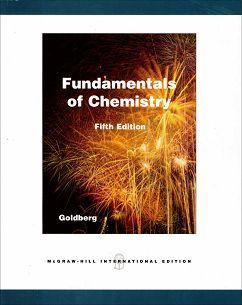
Fundamentals of Chemistry 5/e
售價
$
1,150
- 一般書籍
- ISBN:9780071106627
- 作者:David Goldberg
- 版次:5
- 年份:2007
- 出版商:McGraw-Hill
書籍介紹
目錄
作者介紹
Description
Chemistry is a dynamic and rapidly changing field. It is an extraordinarily interesting subject to study and an intriguing one to teach. The diversity of knowledge of the beginning student presents a unique challenge to the student and to the teacher. This text is written primarily for use in courses designed to prepare students who wish to pursue a science major requiring a comprehensive course in general chemistry. These students, in most cases, have never taken a course in chemistry or have had limited instruction in the basic math that is required to solve chemistry problems, so a chemistry course can be very threatening to them.
To address this issue, this text has four major goals:
Changes in the fifth edition include:
Chemistry is a dynamic and rapidly changing field. It is an extraordinarily interesting subject to study and an intriguing one to teach. The diversity of knowledge of the beginning student presents a unique challenge to the student and to the teacher. This text is written primarily for use in courses designed to prepare students who wish to pursue a science major requiring a comprehensive course in general chemistry. These students, in most cases, have never taken a course in chemistry or have had limited instruction in the basic math that is required to solve chemistry problems, so a chemistry course can be very threatening to them.
To address this issue, this text has four major goals:
- To provide a clear, consistent methodology that a student can follow to develop conceptual and quantitative problem-solving skills.
- To engage the student by relying heavily on analogies that relate chemistry to daily life.
- To anticipate the points where students are apt to have difficulty, and to smooth the path to understanding by explaining in detail what the pitfalls are and how to avoid them.
- To present, at one time, points that may be easily confused with one another so that students can avoid making the errors. For example, if a radioactive decay problem asks for the number of atoms that have disintegratedinstead of the number remaining after a certain time, a student might easily make a mistake. If in one problem both the number disintegrated and the number remaining are required, the student can hardly make that same mistake. In a given chapter some early problems ask related questions together and later ones ask them separately to ensure that the differences are not forgotten.
Changes in the fifth edition include:
- The addition of a NEW Chapter 17 on Electrochemistry, with calculation of potentials and of stoichiometric quantities from electrical quantities and vice versa. Six new in-chapter examples and forty end-of-chapter problems were added, as well as two tables, Table 17.1 "Electrical Variables and Units" and Table 17.2 "Standard Reduction Potentials".
- The addition of a NEW Section 19.5 on Polyprotic Acids, with Table 19.4 on "Selected Dissociation Constants of Polyprotic Acids".
- Changes in positions of several sections for better flow of ideas:
- Chapter 2: Presentation of Exponential Numbers before The Metric System
- Chapter 12: Presentation of Dalton's Law immediately after Ideal Gas Law
- Five new Item of Interest additions:
- Chapter 10: Ion mass in food chemistry
- Chapter 14: High heat of water and steam
- Chapter 17: Purification process of copper Galvanic cell reactions
- Chapter 19: H2S, a dangerous but useful gas
- New Enrichment Box on Controlled Experiments in Chapter 13
- The elimination of section 16.6 on Equivalents and Normality from Chapter 16. These concepts are available online for instructors who want them; contact your McGraw-Hill Sales Representative.
Table of Contents
Chapter 1: Basic Concepts
Chapter 2: Measurement
Chapter 3: Atoms and Atomic Masses
Chapter 4: Electronic Configuration of the Atom
Chapter 5: Chemical Bonding
Chapter 6: Nomenclature
Chapter 7: Formula Calculations
Chapter 8: Chemical Reactions
Chapter 9: Net Ionic Equations
Chapter 10: Stoichiometry
Chapter 11: Molarity
Chapter 12: Gases
Chapter 13: Atomic and Molecular Properties
Chapter 14: Solids, Liquids, and Energies of Physical and Chemical Changes
Chapter 15: Solutions
Chapter 16: Oxidation Numbers
Chapter 17: Electrochemistry
Chapter 18: Chemical Equilibrium
Chapter 19: Acid-Base Theory
Chapter 20: Organic Chemistry
Chapter 21: Nuclear Reactions
Chapter 1: Basic Concepts
Chapter 2: Measurement
Chapter 3: Atoms and Atomic Masses
Chapter 4: Electronic Configuration of the Atom
Chapter 5: Chemical Bonding
Chapter 6: Nomenclature
Chapter 7: Formula Calculations
Chapter 8: Chemical Reactions
Chapter 9: Net Ionic Equations
Chapter 10: Stoichiometry
Chapter 11: Molarity
Chapter 12: Gases
Chapter 13: Atomic and Molecular Properties
Chapter 14: Solids, Liquids, and Energies of Physical and Chemical Changes
Chapter 15: Solutions
Chapter 16: Oxidation Numbers
Chapter 17: Electrochemistry
Chapter 18: Chemical Equilibrium
Chapter 19: Acid-Base Theory
Chapter 20: Organic Chemistry
Chapter 21: Nuclear Reactions
David Goldberg, Brooklyn College
