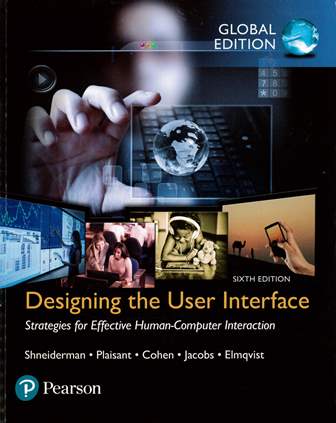
Designing the User Interface: Strategies for Effective Human-Computer Interaction 6/e
售價
$
1,500
- 一般書籍
- ISBN:9781292153919
- 作者:Ben Shneiderman, Catherine Plaisant, Maxine Cohen, Steven Jacobs, Niklas Elmqvist
- 版次:6
- 年份:2018
- 出版商:Pearson Education
- 頁數/規格:622頁/平裝彩色
書籍介紹
本書特色
目錄
作者介紹
Description
The Sixth Edition of Designing the User Interface provides a comprehensive, authoritative, and up-to-date introduction to the dynamic field of human-computer interaction (HCI) and user experience (UX) design. This classic book has defined and charted the astonishing evolution of user interfaces for three decades. Students and professionals learn practical principles and guidelines needed to develop high quality interface designs that users can understand, predict, and control. The book covers theoretical foundations and design processes such as expert reviews and usability testing.
By presenting current research and innovations in human-computer interaction, the authors strive to inspire students, guide designers, and provoke researchers to seek solutions that improve the experiences of novice and expert users, while achieving universal usability. The authors also provide balanced presentations on controversial topics such as augmented and virtual reality, voice and natural language interfaces, and information visualization.
Updates include current HCI design methods, new design examples, and totally revamped coverage of social media, search and voice interaction. Major revisions were made to EVERY chapter, changing almost every figure (170 new color figures) and substantially updating the references.
The Sixth Edition of Designing the User Interface provides a comprehensive, authoritative, and up-to-date introduction to the dynamic field of human-computer interaction (HCI) and user experience (UX) design. This classic book has defined and charted the astonishing evolution of user interfaces for three decades. Students and professionals learn practical principles and guidelines needed to develop high quality interface designs that users can understand, predict, and control. The book covers theoretical foundations and design processes such as expert reviews and usability testing.
By presenting current research and innovations in human-computer interaction, the authors strive to inspire students, guide designers, and provoke researchers to seek solutions that improve the experiences of novice and expert users, while achieving universal usability. The authors also provide balanced presentations on controversial topics such as augmented and virtual reality, voice and natural language interfaces, and information visualization.
Updates include current HCI design methods, new design examples, and totally revamped coverage of social media, search and voice interaction. Major revisions were made to EVERY chapter, changing almost every figure (170 new color figures) and substantially updating the references.
Features
New To This Edition
- Provides a broad survey of designing, implementing, managing, maintaining, training, and refining the user interface of interactive systems, especially mobile devices.
- Describes practical techniques and research-supported design guidelines for effective interface designs.
- Covers both professional applications (e.g. CAD/CAM, air traffic control) and consumer examples (e.g. web services, e-government, mobile devices, cell phones, games, virtual reality).
- Delivers informative introductions to development methodologies, evaluation techniques, and user-interface building tools.
- Offers an extensive array of current examples and figures illustrating excellence in design.
- Includes full-color presentation throughout with commissioned chapter opening artwork.
- Guides students who might be starting their first HCI design project.
- Presents strategies for enhancing quality of user-generated content.
- Focuses on universal usability including special populations, sustainable design, and societal transformation.
- Emphasizes internationalization and customization of interactive systems.
- Includes reports on recent research results and innovative products.
New To This Edition
- Presents the remarkable success story of HCI and user experience design.
- Updates design guidelines, principles, and theories to reflect new ways of thinking.
- Adds new chapters focusing on design and case studies, and updates evaluation techniques.
- Illustrates current designs and practices with 170 new figures.
- Explores progress in direct manipulation toward virtual and augmented reality as well as the broader use of speech interaction.
- Expands the focus on mobile devices.
- Offers a totally new chapter on collaboration and social media.
- Updates vital chapters such as navigation, information search and visualization.
- Presents balanced discussions on topics such as 3-D, speech, natural language interfaces, the degree of human control, and the role of animated characters.
- Summarizes key points in boxes throughout the book.
- Emphasizes issues of universal usability for increasingly diverse users of interactive systems.
- Updates the Practitioner Summaries and Researcher Agendas.
- Adds many new references, while keeping classic papers.
Table of Contents
Part 1. Introduction
1. Usability of Interactive Systems
2. Universal Usability
3. Guidelines, Principles, and Theories
Part 2. Design Processes
4. Design
5. Evaluation and the User Experience
6. Design Case Studies
Part 3. Interaction Styles
7. Direct Manipulation and Immersive Environments
8. Fluid Navigation
9. Expressive Human and Command Languages
10. Devices
11. Communication and Collaboration
Part 4. Design Issues
12. Advancing the User Experience
13. The Timely User Experience
14. Documentation and User Support (a.k.a. Help)
15. Information Search
16. Data Visualization
Part 1. Introduction
1. Usability of Interactive Systems
2. Universal Usability
3. Guidelines, Principles, and Theories
Part 2. Design Processes
4. Design
5. Evaluation and the User Experience
6. Design Case Studies
Part 3. Interaction Styles
7. Direct Manipulation and Immersive Environments
8. Fluid Navigation
9. Expressive Human and Command Languages
10. Devices
11. Communication and Collaboration
Part 4. Design Issues
12. Advancing the User Experience
13. The Timely User Experience
14. Documentation and User Support (a.k.a. Help)
15. Information Search
16. Data Visualization
Ben Shneiderman, University of Maryland
Catherine Plaisant, University of Maryland
Maxine Cohen, Nova Southeastern University
Steven Jacobs, Northern Arizona University
Niklas Elmqvist, University of Maryland
Catherine Plaisant, University of Maryland
Maxine Cohen, Nova Southeastern University
Steven Jacobs, Northern Arizona University
Niklas Elmqvist, University of Maryland